

Field Therapy for Acne Clusters

The Science of Field Therapy: Treating Acne Clusters with Large Hydrocolloid Arrays
In dermatology, there is a concept known as ‘Field Cancerization,’ which suggests that the tissue surrounding a visible lesion is often biologically altered, even if it looks normal to the naked eye. This same logic applies to acne. When you see a cluster of pimples on your chin or cheek, you are not looking at isolated events; you are looking at a ‘Field Defect’—a zone where the microbiome is disrupted, sebum production is dysregulated, and inflammation is rampant. Yet, most consumers attempt to treat these breakout clusters with tiny, isolated 10mm sticker dots. This is geometrically and biologically inefficient. In this engineering white paper, we will explore the superiority of ‘Field Therapy’ using large acne patches for face application, analyzing the mechanics of shear force on the jawline and the thermodynamics of zonal occlusion.
- The Pathophysiology of the “U-Zone” Cluster

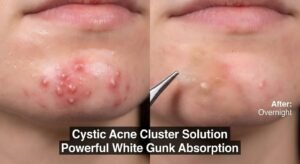
To treat a cluster, we must first define its anatomy. Unlike the T-Zone (Forehead/Nose), which suffers from simple comedones (blackheads), the U-Zone (Cheeks/Jawline) is prone to deep, inflammatory lesions driven by hormones.
a.The Androgen Receptor Density
The sebaceous glands along the mandibular line (jaw) have a higher density of androgen receptors. During stress or menstrual cycles, circulating androgens bind to these receptors, causing an explosion of oil production. This results in the classic hormonal acne chin pattern. Because the trigger is systemic (hormones), the result is rarely a single pimple. It is a minefield of deep cysts.
b.The “Iceberg” Effect
Visible pimples are just the tip of the iceberg. Surrounding every active pustule are dozens of ‘Micro-comedones’—pores that are blocked but not yet inflamed. If you apply a small dot to the visible pimple, you ignore the micro-comedones next door. By the time the first pimple heals, the neighbors have erupted. This creates the frustrating cycle of ‘Never-Ending Breakouts.’肉眼可见的痘痘只是冰山一角。每个活跃的脓疱周围都有数十个“微粉刺”,即毛孔被堵塞但尚未发炎。如果你在可见的粉刺上涂抹一个小点,你就会忽略旁边的微粉刺。当第一个痘痘痊愈时,邻居们已经爆发了。这就造成了“永无休止的突破”的令人沮丧的循环。
- The Physics of Field Therapy: Discrete vs. Continuous
Switching from dots to xl pimple patches changes the thermodynamics of the treatment.
Uniform Micro-Climate
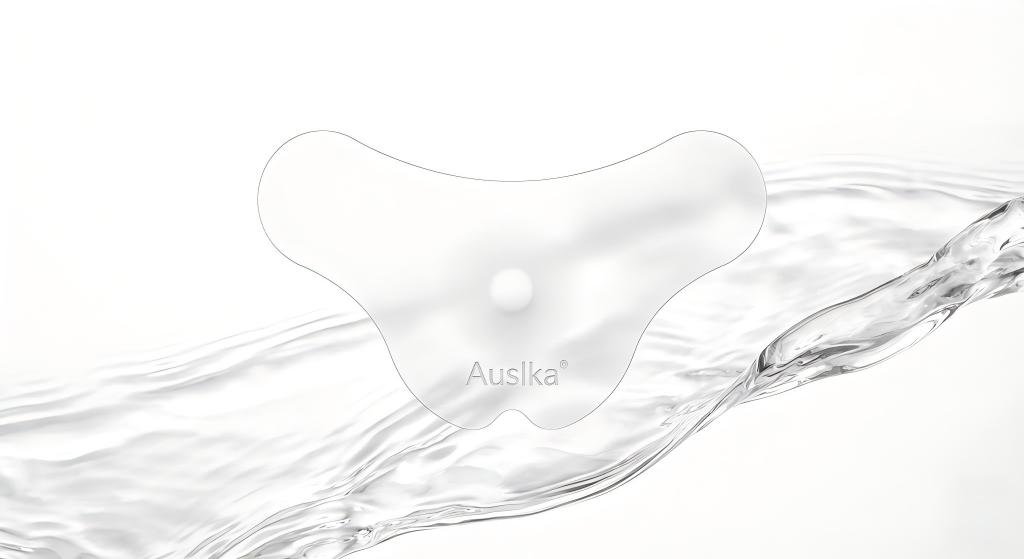
A standard dot creates a micro-climate over 0.8 cm² of skin. An Auslka XL patch covers 25+ cm². By covering the entire ‘Field,’ you create a uniform zone of hydration and stable temperature. This softens the keratin plugs of *all* pores in the area, not just the infected ones, effectively treating the visible acne while preventing the micro-comedones from maturing into cysts.
Biofilm Disruption
- acnes bacteria thrive by forming a ‘Biofilm’—a sticky web that protects them from antimicrobials. A continuous large patch cuts off the oxygen supply (creating an anaerobic environment, which usually C. acnes likes, BUT…) crucially, it traps the bacteria in a sterile environment where they cannot recruit new resources or spread to adjacent pores via surface sebum. The hydrocolloid matrix absorbs the biofilm matrix (exudate), physically dismantling the bacterial fortress.
- Biomechanics of Adhesion: The Jawline Problem
Why do small patches fall off your chin? It is a problem of Mechanical Engineering: Shear Force.
The Geometry of Talking
The chin is the most mobile part of the face. Every time you speak or chew, the skin stretches and contracts. A small circular dot has a limited adhesive surface area. The shear force of the skin moving underneath it easily breaks the adhesive bond. This makes spot treatment an ineffective jawline acne treatment.
The Auslka Contoured Solution
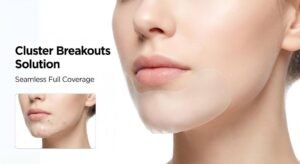
Auslka’s large patches utilize ‘Contoured Geometry.’ By increasing the surface area and curving the design to fit the mandibular bone, the patch distributes the mechanical stress across a wider area. The shear force is absorbed by the elastomer matrix rather than the adhesive interface. This ensures the patch stays sealed throughout the night, providing continuous cystic acne cluster solution even for restless sleepers.
- The Psychology of “Picking Trances”
Cluster acne triggers a specific psychological response: Dermatillomania (Skin Picking Disorder). When a patient feels an uneven texture (bumps) on their cheek, they often enter a ‘Picking Trance,’ unconsciously scanning and scratching the area.
Tactile Interruption
Small dots leave the skin *between* pimples exposed. The fingers can still feel the texture of the untreated bumps, triggering the urge to pick. An XL patch acts as a ‘Tactile Interrupter.’ It smooths over the entire texture of the breakout zone. When the fingers touch the face, they feel the smooth, cool plastic instead of the inflamed bumps. This breaks the neural feedback loop of picking, preventing the secondary infection that turns a 3-day breakout into a 3-month scar.
- Protocol: Mapping Your Treatment
Stop playing ‘Whac-A-Mole’ with your acne. Use this zonal map:
Zone A: The Hormonal Chin (The U-Shape)
- Pathology: Deep cysts, intertwined roots.
- Solution: Auslka XL Chin Patch.
- Application: Apply with mouth slightly open to stretch the skin. This prevents wrinkling/bubbling when you close your mouth.
Zone B: The Congested Cheeks (The Rectangle)
- Pathology: Friction acne (Maskne), bacterial transfer from pillowcases.• Function: These acne strips for cheeksact as a shield against friction while extracting oil.
- Solution: Auslka XL Square Patches.
Zone C: The Oily Nose (The Triangle)
- Pathology: Sebaceous filaments, oxidized blackheads.• Mechanism: A gentle nose pore strips alternative. Unlike pore strips that rip out hair and skin (mechanical trauma), hydrocolloid chemically softens and absorbs the oil plug over 6 hours.
- Solution: Auslka Hydrocolloid Nose Strip.
- The Economics of Compliance
Medical adherence decreases as complexity increases. Asking a user to apply, center, and smooth out 12 individual dots takes time and precision. Applying 1 large patch takes 5 seconds.
- Cost Efficiency: A severe breakout (covering 10cm²) requires ~15 small dots ($3.00 value). One XL patch covers the same area ($0.80 value).
- Efficacy Efficiency: Because the XL patch is less likely to fall off (due to better shear resistance), the active ingredient time-on-skin is higher, leading to faster resolution.
- Clinical FAQ
Q: Does the large patch suffocate the skin?
A: No. Auslka’s large hydrocolloid patch technology is semi-permeable. It allows oxygen to penetrate (preventing anaerobic bacterial explosion) and moisture vapor to escape (preventing maceration), while blocking external bacteria.
Q: Can I overlap patches?
A: It is not recommended. Overlapping creates a seam where air can enter, breaking the sterile vacuum. It is always better to use a single larger patch or cut a custom shape from an XL sheet.
Final Thoughts
Treating acne clusters with small dots is like trying to put out a forest fire with a water pistol. You are treating the symptom, not the environment. By adopting a ‘Field Therapy’ approach with XL patches, you address the biomechanics of the jawline, the psychology of picking, and the biology of the acne micro-environment simultaneously. Stop spotting. Start mapping. Explore the full range of Auslka Large Surface Patches.