

The Physics of Adhesion & Layering

The Architecture of Adhesion: Integrating Hydrocolloid into Complex Skincare Regimens
In the intricate world of modern dermatology, the efficacy of a product is not solely defined by its active ingredients, but by its application protocol. A common failure mode we observe in clinical feedback is the complaint: ‘The patch didn’t stick.’ In 95% of cases, this is not a manufacturing defect, but a thermodynamic error in the skincare layering guide. Understanding **surface energy** and **lipid interference** is critical. If you apply a hydrophobic (oil-based) moisturizer before a hydrocolloid patch, you have effectively greased the surface, rendering adhesion impossible. In this technical guide, we will define exactly when to apply pimple patch technologies within AM and PM routines to ensure maximum structural integrity and absorption.
- The Surface Chemistry of Adhesion: Why “Clean & Dry” Matters

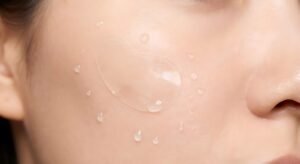
To understand the correct order, we must understand how a patch sticks. Auslka patches rely on a combination of ‘Mechanical Interlocking’ (gripping the texture of the skin) and weak ‘Van der Waals forces’ (molecular attraction).
The Lipid Interference Factor
Human sebum, moisturizers, and facial oils are ‘Lipids.’ They function as lubricants. If you attempt to place a patch over a lipid layer, the adhesive matrix cannot contact the keratinocytes (skin cells). It floats on top of the oil film. This is why clean dry skin for patches is not just a suggestion; it is a physical requirement. Even a microscopic layer of Toner or Essence can reduce adhesion strength by 60%.
- The Definitive Protocol: The “Sandwich” Method
To integrate patches into a multi-step routine (Cleanser -> Toner -> Serum -> Moisturizer), you must interrupt the flow.
Step 1: Chemical Strip (Cleansing)
Use a surfactant-based cleanser to remove surface oils. Rinse thoroughly.
Step 2: Desiccation (Drying)
Pat the face dry. Wait 60 seconds to ensure all transepidermal water has evaporated from the surface.
Step 3: Structural Bonding (The Patch)
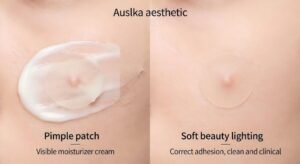
Apply the Auslka patch *immediately* to the bare pimple. Press down for 5 seconds. The body heat helps the hydrocolloid matrix flow slightly into the skin’s texture, locking it in. This creates the essential seal for patch adhesion tips.
Step 4: The “Donut” Technique (Everything Else)
Now, apply your Toners, Serums, and Moisturizers. But here is the key: Apply them *around* the patch, not over it. Treat the patch like the hole in a donut. This ensures the surrounding skin is hydrated without compromising the adhesive seal of the treatment zone.
- AM Routine: Optical Engineering & Makeup
Daytime application presents a different challenge: Aesthetics. Users want an invisible pimple patch under makeup.
Light Diffusion Physics
Auslka patches are engineered with a matte, tapered edge. In optics, a glossy surface reflects light (Specular Reflection), drawing attention to the bump. A matte surface scatters light (Diffuse Reflection), blending the bump into the surrounding skin texture.
Makeup Compatibility Protocol
- Apply Patch to clean skin.
- Apply SPF/Moisturizer (Donut method).
- Apply Foundation/Concealer. You can apply makeup over pimple patchsurfaces. Because the patch is non-porous, it prevents the makeup pigment from entering the open wound, which would otherwise cause granulomas or infection.
- PM Routine: Active Ingredient Integration
Nighttime is for repair. Your night skincare routine acne strategy likely involves actives like Retinol or Acids.
The Interaction Warning
Applying a patch *over* strong actives (like Tretinoin or 2% Salicylic Acid) increases their penetration by 10-20x due to occlusion. This can lead to chemical burns.
The Safe Method
Always apply the patch to clean skin first. Then, apply your Retinol or serum application acne products to the rest of the face, avoiding the patch area by 5mm. The patch protects the sensitive, inflamed skin from the irritation of the Retinol while it extracts the infection.
- Failure Analysis: Why “Moisturizer First” Fails
We receive inquiries about moisturizer over acne patch versus under. Let’s analyze the physics of ‘Under’.
If you apply moisturizer first, you create a lipid film. Hydrocolloid is Hydrophilic (water-loving) but Lipophobic (oil-hating). When the patch touches the moisturizer:
- Phase Repulsion: The adhesive repels the oil.
- Migration: The patch slides across the face (Shear failure).
- Barrier Blockage: The moisturizer acts as a barrier, preventing the patch from sensing the exudate in the pimple. The extraction mechanism is blocked.
Conclusion: Never apply moisturizer under a patch.
- Clinical FAQ & Troubleshooting
Q1: Can I use toner before the patch?
A: Only if it is a watery, astringent toner that evaporates completely with zero residue. If it is a hydrating toner (viscous), it will compromise adhesion. Safer to patch first.
Q2: How do I remove the patch without hurting?
A: Do not rip it off like a band-aid. Stretch the patch outwards parallel to the skin (like a Command Strip) to release the bond gently. This prevents disrupting the healing tissue.
Q3: Sunscreen over or under?
A: Over. Sunscreen contains oils/silicones that ruin adhesion. Patch first, then apply SPF over the patch. The patch itself also physically blocks UV rays.
Q4: Can I reuse a patch if I placed it wrong?
A: No. Once the adhesive matrix touches skin oils, its structural integrity is compromised. Using a fresh patch ensures proper hygiene and stickiness.
Q5: Why does the patch turn white on the edges?
A: This usually means moisture (sweat or water) has entered from the side, or you applied it over damp skin. A proper seal should only turn white in the center (over the pimple).
Q6: Can I sleep with it?
A: Yes. In fact, we recommend it. The Auslka Patch protects the zit from friction against your pillowcase, which is a major cause of acne aggravation.
Final Thoughts
Skincare is chemistry, and the order of operations matters. By respecting the laws of adhesion and applying your Auslka patch to clean, dry skin, you ensure that the technology functions as engineered. Don’t waste a good patch on a slippery surface. Master the layer, master the clear skin. Shop our Day & Night Patch Kit.