

Barrier Repair 101: How to Fix “Over-Exfoliated” Skin

Introduction: The “TikTok Trend” Hangover

We have all seen the viral skincare trends: 10-step routines, aggressive acid peels, and ‘glass skin’ challenges that involve layering multiple actives. It is tempting to try them all. But for many, this enthusiastic experimentation leads to a rude awakening.
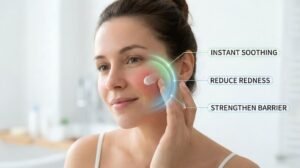
You wake up one morning, and your usual gentle cleanser stings. Your cheeks are flushed with persistent redness that makeup can’t quite cover. Your skin feels tight, almost like it’s too small for your face. These are not signs that the products are ‘working’—they are the classic symptoms of over-exfoliated skin.
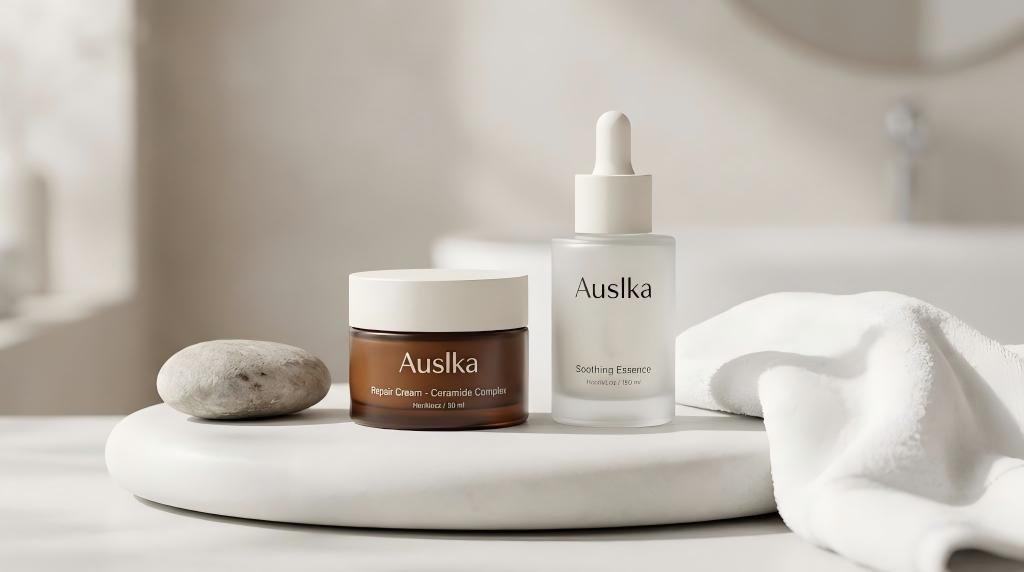
You have stripped your acid mantle. When this happens, the solution isn’t more actives. It is a radical return to basics. In this guide, we will break down the science of damaged skin barrier repair and introduce the ‘Bandage’ protocol using Auslka’s high-performance Repair Series.
Understanding the Acid Mantle: Your Skin’s Invisible Shield

Before we can fix the problem, we need to understand what broke. Your skin is protected by a thin, slightly acidic film called the acid mantle. Think of it as your skin’s security guard. It is composed of sebum (oil), sweat, and lipids.
This barrier serves two critical functions:
- Keep the Bad Out: Blocking bacteria, pollution, and irritants.
- Keep the Good In: Preventing Transepidermal Water Loss (TEWL).
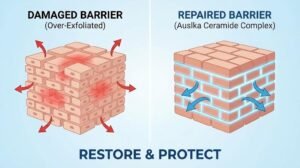
When you over-exfoliate with AHAs/BHAs or harsh scrubs, you physically scour away this protective shield. The mortar holding your skin cells together dissolves. The result? ‘Leaky’ skin. Water evaporates rapidly, and bacteria enters freely.
The ‘Bandage’ Effect: Why Your Moisturizer Needs to Be Biologically Identical
Once the barrier is compromised, a standard lotion isn’t enough. You need a product that mimics the skin’s natural structure. This is the engineering philosophy behind the Skin Repairing Essence Cream ($119).
Why the premium price tag? It comes down to the Lipid Ratio.
Healthy skin cells are held together by a specific matrix of lipids: Ceramides, Cholesterol, and Fatty Acids. Auslka’s cream is formulated with a biomimetic lipid complex that delivers these in a ratio your skin recognizes.
- Ceramides: Act as the ‘bricks,’ rebuilding structural integrity.
- Cholesterol: Acts as the ‘mortar,’ providing fluidity and elasticity.
When you apply this cream, it creates a ‘breathable bandage’ that accelerates healing from the inside out. This is the ultimate ceramide cream benefit.
The Soothing Layer: Putting Out the Fire
While the cream repairs the structure, you first need to address the immediate inflammation. Enter the Renewing and Soothing Repairing Essence ($109).
Think of this as the fire extinguisher. Before you can rebuild the house, you have to put out the fire. This essence is packed with potent anti-inflammatory botanicals designed to lower the skin’s temperature and reduce redness upon contact.
Why use both? The Essence penetrates deep to calm the immune response, while the Cream seals it all in. Using the cream without the essence is like putting a bandage on a dirty wound—you need to soothe the underlying inflammation first.
Nighttime Recovery Ritual: ‘Slugging’ vs. ‘Creaming’
We recommend the ‘High-Performance Creaming’ method for a more elegant recovery than messy slugging.
- Cleanse: Use a non-foaming, milk cleanser.
- Soothe: Apply 2-3 pumps of Renewing and Soothing Repairing Essence while skin is still damp.
- The ‘Bandage’ Layer: Take a generous amount of Skin Repairing Essence Cream. Warm it between your fingers.
- Don’t Rub It In Completely: Leave a slight visible layer on sensitive areas. Let it absorb naturally over 15 minutes.
Unlike slugging with petrolatum, which creates an impermeable seal, this method allows your skin to breathe while feeding it the lipids it is starving for.
FAQ: Navigating the Healing Process
Q1: Can I use retinol while repairing my barrier?
A: Absolutely not. Retinol increases cell turnover, which is the opposite of what you need right now. Pause all actives (Retinol, Vitamin C, AHAs, BHAs) for at least 2 weeks. Focus entirely on hydration and repair.
Q2: How long does repair take?
A: It depends on the damage. For mild irritation, 3-5 days. For a severely damaged barrier (constant redness), the skin cycle takes about 28 days to fully reset. Patience is key.
Q3: Will the rich cream cause acne?
A: A damaged barrier is actually a leading cause of acne because bacteria can easily penetrate. By repairing the barrier with the correct lipid ratio, you are restoring the skin’s defense system. If you are very oily, use the cream primarily at night.
Q4: Can I use this routine if I have eczema?
A: Yes. Eczema is fundamentally a defect in the skin barrier. The ceramides and cholesterol in our Repair Series are exactly what eczema-prone skin lacks to stay healthy.
Q5: Why does my face sting even when I use water?
A: This is a sign of a severely compromised barrier. Your nerve endings are exposed. In this stage, skip morning cleansing entirely and just use the Soothing Essence. Only cleanse at night with a gentle, non-foaming cleanser.
Q6: Can I use Vitamin C in the morning?
A: We recommend pausing L-Ascorbic Acid (Vitamin C) until the stinging stops. Vitamin C is acidic and can further irritate a broken barrier. Once your skin feels strong again, reintroduce it slowly.
Conclusion: Healing is a Marathon, Not a Sprint
Damaging your skin barrier takes minutes of over-exfoliation, but fixing it takes weeks of patience. The journey back to healthy skin isn’t about doing more; it’s about doing better.
By investing in premium, biomimetic ingredients found in the Auslka Repair Series, you aren’t just moisturizing dead skin cells—you are rebuilding the very architecture of your face.
Treat your skin with kindness, feed it the lipids it craves, and it will reward you with a resilience and glow that no highlighter can mimic. Shop the Repair Series