

Best Ingredients for Your Anti-Acne Series: Salicylic Acid & Niacinamide

Introduction

Navigating the volatile biochemical landscape of clinical dermatology requires absolute precision, particularly when engineering therapeutic protocols for acne vulgaris. For independent beauty founders and medical aesthetics practitioners, formulating an effective blemish control line frequently introduces severe ingredient-confusion pain points. When amateur formulators blindly compound incompatible acids, they systematically induce compromised skin barriers, aggressive post-inflammatory hyperpigmentation (PIH), and severe chemical burns. To mathematically eradicate these physiological liabilities, sourcing the absolute most effective anti-acne skincare ingredients is the paramount foundational step. However, simply identifying these compounds is insufficient; the true biochemical engineering challenge lies in perfectly stabilizing and delivering these volatile molecules deep into the dermal matrix without triggering an inflammatory cascade.
Historically, mass-market blemish treatments relied on extremely aggressive, singular active agents—such as high-percentage unbuffered Benzoyl Peroxide, harsh denatured alcohols, or archaic physical abrasives. While these rudimentary formulations rapidly desiccate the superficial layers of the epidermis, they catastrophically destroy the intercellular lipid matrix, triggering a violent surge in reactive sebum overproduction and chronic trans-epidermal water loss (TEWL). Modern dermatological science strictly mandates a dual-action approach: aggressively purging the infected pilosebaceous unit while simultaneously reconstructing the compromised epidermal barrier.
To achieve this exact biochemical equilibrium, the integration of Salicylic Acid (BHA) and Niacinamide (Vitamin B3) has emerged as the undisputed gold standard in clinical formulation. This comprehensive B2B technical guide will aggressively deconstruct the lipophilic penetration mechanics of BHA, evaluate the ceramide-synthesizing properties of Niacinamide, and detail exactly how partnering with an elite Salicylic acid OEM guarantees your brand delivers uncompromising, medical-grade efficacy without risking catastrophic epidermal barrier failure.
Core Lipophilic & Anti-Inflammatory Advantages

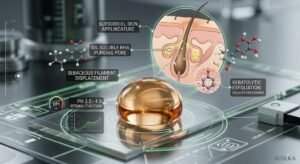
To objectively comprehend the clinical superiority of this specific chemical synergy, formulation engineers must deeply analyze the molecular geometry and solubility parameters of the active compounds. Salicylic Acid is a Beta Hydroxy Acid (BHA) characterized by its inherently lipophilic (oil-soluble) molecular structure. Unlike Alpha Hydroxy Acids (AHAs), which are strictly hydrophilic (water-soluble) and confined to superficial surface exfoliation, a meticulously formulated acne fighting ingredients serum utilizing BHA physically bypasses the aqueous surface layers. It penetrates directly into the lipid-rich environment of the sebaceous gland, locating the precise anatomical site of the acne vulgaris infection.
Once inside the pore, the Salicylic Acid mathematically dissolves the desmosome bonds holding the keratinized cellular debris and oxidized sebum together (the microcomedone). This intense comedolytic and keratolytic action fundamentally dismantles the physical blockage causing the acne lesion. Furthermore, Salicylic Acid possesses an intrinsic structural relationship with acetylsalicylic acid (aspirin), granting it profound, localized anti-inflammatory properties that immediately begin to shrink the swollen follicle. However, this aggressive internal exfoliation must be immediately countered by robust barrier-repair mechanisms to prevent cellular dehydration. This is precisely where Niacinamide (Vitamin B3) becomes biochemically indispensable.
Niacinamide operates as a highly potent cell-communicating ingredient. When applied to a compromised epidermis, it rapidly upregulates the biosynthesis of ceramides, free fatty acids, and cholesterol—the three primary components of the intercellular lipid matrix. By physically rebuilding this structural barrier, Niacinamide mathematically halts the trans-epidermal water loss (TEWL) induced by the BHA exfoliation. Additionally, Niacinamide directly interacts with the sebocytes, aggressively downregulating the overproduction of sebum. This dual-action synergy creates an optimized, self-regulating dermal environment: the BHA continuously clears the existing blockages from the inside out, while the Niacinamide structurally reinforces the surface barrier and suppresses the primary lipid catalyst of future cystic breakouts.
Critical Market Applications & Real-World Use Cases
The strategic deployment of this specific biochemical synergy is aggressively dictated by the rigorous demands of professional dermatologists and high-end aesthetic clinics. In the highly sterile environment of advanced medical spas, practitioners frequently treat severe Grade III and Grade IV cystic acne. These patients present with highly compromised, intensely inflamed epidermal barriers that absolutely cannot tolerate archaic, abrasive physical scrubs or highly concentrated benzoyl peroxide. Consequently, clinical operators require highly calibrated, dual-action therapeutic protocols that heal the tissue without inflicting secondary chemical burns.
Therefore, these medical professionals actively partner with a premium niacinamide serum manufacturer to engineer and prescribe customized, sterile at-home maintenance regimens. Furthermore, by deploying an OEM serum that mathematically balances a sustained-release 2% Salicylic Acid matrix with 5% Niacinamide, the clinic ensures the patient receives aggressive comedolytic clearing without inducing severe localized erythema. Consequently, this precise formulation protocol significantly accelerates the healing timeline and dramatically reduces the formation of post-inflammatory hyperpigmentation (PIH). Furthermore, to elevate the soothing profile of these clinical solutions, elite manufacturers incorporate highly purified botanical synergists. Therefore, by sourcing subcritical fluid-extracted Centella Asiatica directly from high-altitude, organic cultivation zones in Guizhou, China, the formulation achieves exceptional anti-inflammatory properties. Consequently, this proprietary distribution model legally isolates the patient from inferior mass-market alternatives, thereby locking in continuous, high-margin retail revenue for the clinic.
Furthermore, sophisticated direct-to-consumer (DTC) beauty brands leverage this exact ODM infrastructure to rapidly dominate the specialized blemish control market. Therefore, when a brand identifies a lucrative gap in the market for a non-irritating private label spot treatment, they utilize their factory partner to engineer advanced hydrocolloid delivery systems impregnated with this exact BHA, Niacinamide, and Guizhou botanical extract matrix. Consequently, because the OEM factory handles the strict biochemical stabilization, complex emulsion thermodynamics, and aseptic packaging, the brand founder can remain hyper-focused on aggressive customer acquisition and marketing logistics. Therefore, this strategic outsourcing mathematically isolates the emerging brand from the immense capital expenditures required to establish independent, ISO-certified cosmetic laboratories.
Comparison Table: Blemish Treatment Modalities
To objectively evaluate the clinical and structural viability of varying acne treatments, cosmetic engineers must critically analyze the biochemical deployment data. The following 4-column table mathematically contrasts the BHA + Niacinamide Synergy against archaic industry alternatives across critical dermatological performance metrics.
| Treatment Modality | Pore Penetration & Sebum Regulation | Skin Barrier Health & Hydration | Melanin Regulation & Irritation Risk |
| BHA + Niacinamide Synergy | Supreme. BHA dissolves sebum internally; Niacinamide reduces overall oil production. | Excellent. Rapidly synthesizes ceramides, effectively halting trans-epidermal water loss. | Minimal Irritation. Niacinamide physically blocks melanosome transfer, preventing dark spots. |
| Benzoyl Peroxide (BPO 10%) | Moderate. Oxygenates the pore to kill bacteria but does not actively dissolve sebum. | Catastrophic. Generates massive free radicals; severely strips the intercellular lipid barrier. | High Irritation. The extreme inflammation actively triggers post-inflammatory hyperpigmentation (PIH). |
| Physical Scrubs (Walnut/Apricot) | Zero. Physically impossible for jagged macro-particles to penetrate the pilosebaceous unit. | Terrible. Inflicts microscopic lacerations on the stratum corneum, spreading bacteria rapidly. | High Irritation. Friction-induced trauma significantly darkens existing acne scars and active cysts. |
| Tea Tree Extract (Unformulated) | Low. Mild antibacterial properties, but completely lacks keratolytic (exfoliating) capability. | Variable. Highly volatile essential oils frequently induce severe allergic contact dermatitis. | Moderate Irritation. Does not possess any active melanin-inhibiting pathways to fade scarring. |
Blending Best Practices & Chemical Specs
Executing a flawless commercial launch of a dual-active blemish serum requires absolute adherence to biochemical thermodynamics and strict pH stabilization. Combining Salicylic Acid and Niacinamide in a single aqueous solution introduces severe chemical engineering challenges that routinely defeat amateur laboratories. The absolute most critical operational parameter is the calculation of the ‘free acid value’ (pKa). Salicylic acid has a precise pKa of 2.97. For the BHA to remain biologically active and capable of penetrating the lipid barrier, the serum must be mathematically buffered to a final pH strictly between 3.5 and 4.0. A premier custom blemish cosmetics factory strictly utilizes advanced sodium citrate and phosphate buffers to lock the pH within this highly active window.
[Image detailing the chemical hydrolysis of Niacinamide into Nicotinic Acid in low-pH environments]
However, this optimal acidic environment is inherently hostile to Niacinamide. When exposed to a highly acidic pH (below 4.0) for extended periods or subjected to extreme thermal stress during international shipping, Niacinamide undergoes a destructive chemical process known as hydrolysis. The molecule fundamentally breaks down into Nicotinic Acid. When applied to the human epidermis, Nicotinic Acid triggers massive vasodilation of the superficial capillaries, resulting in a severe, hot, red flushing of the skin commonly referred to as the ‘Niacin Flush’. While technically temporary and harmless, this intense erythema frequently causes consumers to panic, triggering immediate product returns and catastrophic brand damage.
To permanently bypass this chemical incompatibility, advanced OEM formulators utilize structural compartmentalization. They deploy sophisticated micro-encapsulation technology to wrap the Niacinamide inside a pH-resistant polymeric lipid shell, protecting it from the acidic BHA suspension. Alternatively, they utilize dual-chamber airless pump packaging, where the BHA and Niacinamide remain physically isolated in separate thermodynamic chambers and are only mathematically blended at the exact millisecond of extrusion onto the consumer’s skin. This complex engineering guarantees 100% active potency of the chemical exfoliant while permanently eradicating the threat of Nicotinic Acid conversion.
Frequently Asked Questions (FAQ)
- Why does Salicylic Acid frequently crystallize in amateur serum formulations?
Salicylic acid is notoriously difficult to dissolve in standard water-based emulsions. Amateur formulators often fail to utilize the correct cosolvents. A professional OEM laboratory will mathematically calculate precise ratios of specialized glycols—such as Propanediol or Propylene Glycol—to completely solubilize the BHA powder, permanently preventing jagged crystal formation that can severely abrade the skin upon application.
- Can I combine AHA (Glycolic Acid) and BHA (Salicylic Acid) in the same OEM product?
Yes, this is known as a comprehensive multi-acid complex. However, because both acids compete for the same low-pH stabilization window, the total acid concentration must be rigorously controlled to prevent catastrophic barrier destruction. Advanced factories will buffer a precise blend of 5% AHA and 2% BHA, heavily infusing high-purity Centella Asiatica to simultaneously soothe the resulting chemical stress.
- What is the maximum legal concentration of Salicylic Acid permitted in OTC acne products?
According to stringent global regulatory frameworks, including the US FDA monograph for topical acne products and the EU Cosmetics Regulation, Salicylic Acid is strictly limited to a maximum concentration of 2.0% for leave-on products (serums, creams) designed for facial application. Exceeding this exact limit classifies the product as a regulated prescription pharmaceutical.
- Does the OEM factory source premium botanical ingredients to support these chemical actives?
Absolutely. Advanced manufacturing hubs provide unparalleled access to highly potent, organically cultivated botanical derivatives. For instance, premium extracts like pure Green Tea polyphenols or Centella Asiatica are sourced from pristine cultivation zones in Guizhou, China. These are processed using subcritical fluid extraction to guarantee zero thermal degradation, acting as vital, soothing antioxidants alongside the harsh BHA acids.
- How does the factory ensure the final BHA product does not clog pores (comedogenic rating)?
Every secondary ingredient within the emulsion—from the structural thickeners to the lipid emollients—must undergo rigorous comedogenic rating analysis. The OEM laboratory physically evaluates the raw materials to guarantee they score a strict ‘0’ on the comedogenic scale, mathematically ensuring the base vehicle absolutely cannot induce microcomedone formation under extended, occlusive wear.
- What is the optimal concentration of Niacinamide to pair with Salicylic Acid?
While Niacinamide is highly tolerable, clinical data proves that the optimal therapeutic window for barrier repair and sebum regulation is strictly between 2.0% and 5.0%. Formulations aggressively pushing 10% or 20% Niacinamide offer zero additional clinical benefit for acne vulgaris; they merely vastly increase the mathematical probability of severe contact dermatitis and skin flushing.
Conclusion
The engineering reality within clinical dermatology is irrefutable: attempting to launch a highly efficacious blemish solution without the rigorous biochemical infrastructure of a professional manufacturing partner guarantees catastrophic barrier failure, severe ingredient hydrolysis, and ultimate brand rejection. By migrating your brand’s production to a precision-engineered anti-acne series developed by an elite OEM facility, you permanently mathematicalize your product’s safety, stability, and clinical efficacy. You guarantee absolute pH stabilization, eradicate the threat of ingredient crystallization, and unlock rapid speed-to-market for your entire therapeutic catalog.
Do not compromise your patients’ dermal health with unstable, amateur formulations. Whether you are seeking to launch an advanced serum within a broader Skincare Series or require a high-throughput manufacturing partner to expand your clinical cosmetic empire, explore the immense capabilities of our GMPC-certified infrastructure. To understand our comprehensive quality control protocols, visit About Us. Secure your clinical dominance by upgrading your supply chain today. Contact the formulation engineers at Auslka to receive a customized thermodynamic formulation audit, and fundamentally revolutionize your beauty brand’s trajectory.