

The Bio-Physics of Hydrocolloid Technology


The Science of Gunk: A Dermatological Analysis of Hydrocolloid Dynamics
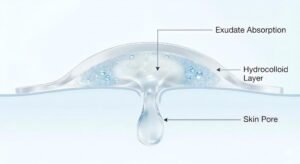
In the realm of modern skincare, few phenomena are as visually satisfying—or as misunderstood—as the ‘White Spot’ on a used acne patch. You apply a translucent sticker to an inflamed pustule before bed, and by morning, it has transformed into an opaque, white shield, while the pimple underneath is visibly flattened. Many consumers colloquially refer to this white gunk on pimple patch as ‘pus,’ assuming the sticker has simply acted as a vacuum. While partially true, the biological reality is far more sophisticated. This process represents a complex interaction of polymer science, osmotic pressure, and wound healing biology. In this technical white paper, we will deconstruct how hydrocolloid patches work, moving beyond marketing fluff to explain the precise mechanism of exudate management and why this medical-grade technology is superior to traditional spot treatments.
- Material Science: The Polymer Matrix
To understand the mechanism, we must first analyze the material. Hydrocolloid is not a single ingredient; it is a composite material system originally engineered for chronic wound care (ulcers and burns) in the 1980s.
A high-quality hydrocolloid bandage for face application, like those manufactured by Auslka, consists of two distinct layers working in unison:
- The Hydrophilic Phase (The Active Agents)
Suspended within the adhesive matrix are microscopic particles of Sodium Carboxymethylcellulose (CMC), gelatin, or pectin. These particles are ‘Hydrophilic’ (water-loving). In their dry state within the patch, they are tightly coiled polymer chains.
- The Hydrophobic Phase (The Structural Matrix)
These CMC particles are embedded in a ‘Hydrophobic’ (water-repelling) elastomer matrix, typically polyurethane or polyisobutylene. This matrix provides structural integrity, adhesion (stickiness), and acts as a barrier against external contaminants.
The Phase Transformation: The visual transformation—the ‘White Gunk’—is the result of a physical Phase Change. When the CMC particles come into contact with fluid (exudate, oil, or pus), they hydrate and uncoil. They bond with water molecules to form a cohesive gel. This gel occupies significantly more physical volume than the dry particle. Therefore, the white spot you see is not pure pus. It is a colloidal suspension of hydrated CMC polymer gel that has trapped the physiological fluids within its molecular lattice.
- The Physics of Extraction: Osmotic Gradients
How does the fluid get from deep inside your pore into the patch? It is driven by the laws of thermodynamics, specifically Osmotic Pressure. This is the core of the acne sticker mechanism:
- The Gradient: An inflammatory lesion (pimple) contains a high concentration of water-based fluids (plasma, neutrophils, bacteria). The dry hydrocolloid patch represents an environment of extremely low moisture potential.
- Equilibrium: Following the Second Law of Thermodynamics, moisture moves from the area of high concentration (the zit) to the area of low concentration (the dry patch) to attempt to achieve equilibrium. This creates a powerful vertical wicking action. This exudate absorptioneffectively drains the lesion without the mechanical trauma of squeezing.
- The Biology of Healing: Winter’s Theory
For decades, conventional wisdom dictated that we should ‘let a wound breathe’ or dry it out with alcohol. However, in 1962, Dr. George D. Winter published a landmark paper in Nature that revolutionized wound care. He proved that wounds heal 2x faster in a moist environment. This is the principle of moist wound healing.
Why Scabs are the Enemy
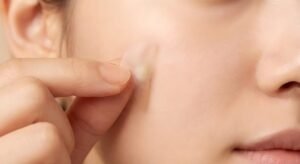
When you let a pimple air-dry, it forms a scab (eschar). While a scab protects the wound, it acts as a physical barrier to Epithelialization. New skin cells (keratinocytes) cannot crawl over a dry, crusty scab. They must burrow underneath it to close the wound. This burrowing process consumes metabolic energy and time, prolonging inflammation and increasing the risk of pitted scarring (atrophic scars).
The Hydrocolloid Advantage
By sealing the pimple with a sterile acne covering, the Auslka patch mimics the body’s natural tissue conditions (homeostasis). It prevents scab formation. This allows new skin cells to migrate rapidly across the surface of the wound bed in a straight line. The result is not just faster healing, but *flatter* healing with significantly less Post-Inflammatory Hyperpigmentation (PIH).
- The Bacterial Shield: Semi-Permeability
An essential feature of Auslka’s technology is its Moisture Vapor Transmission Rate (MVTR). The patch is engineered to be Semi-Permeable.
- Gas Permeable: It allows oxygen and excess water vapor to slowly evaporate out. This prevents the skin from macerating (turning white and mushy from too much trapped moisture), which can damage healthy skin.
- Bacteria Impermeable: The pore size of the polyurethane backing is too small for bacteria (like Staphylococcus aureus or C. acnes) to penetrate.
This creates a biological firewall. You stop introducing new bacteria from your fingers (a major cause of secondary infection), while the patch works to resolve the existing infection.
- Comparative Analysis: Physical vs. Chemical
Why choose a physical patch over chemical creams? Let’s analyze the hydrocolloid dressing benefits from a clinical perspective.
| Parameter | Drying Lotions (Benzoyl Peroxide) | Auslka Hydrocolloid Patch |
| Mechanism of Action | Chemical Oxidation / Dehydration | Physical Absorption / Osmosis |
| Effect on Skin Barrier | Disrupts lipid barrier, causes flaking | Maintains barrier integrity |
| UV Protection | Zero (Exposed to Sun) | 100% Physical Block (Prevents dark spots) |
| Scarring Risk | High (Scabs promote picking) | Low (Prevents picking reflex) |
- Pimple Patch Ingredients: The Importance of Purity
Not all patches are created equal. Since this product sits on an open wound for 8+ hours, the purity of pimple patch ingredients is paramount. Lower-quality patches often use aggressive acrylic adhesives to save costs. These can cause contact dermatitis, leaving a red ring around the pimple that lasts longer than the acne itself. Auslka utilizes a medical grade hydrocolloid formulation. It is hypoallergenic and relies on the adhesive properties of the hydrocolloid matrix itself rather than added glues.
- FAQ: Clinical Usage Protocols
Q: Can I use this on a blind cyst (nodular acne)?
A: Hydrocolloid requires a route for fluid extraction. For deep cysts with no ‘head,’ the patch cannot utilize osmotic pressure to absorb fluid. However, it remains valuable as an occlusive barrier to prevent Dermatillomania (compulsive picking) and to enhance the penetration of underlying topicals.
Q: Should I pop the pimple before applying?
A: Clinical best practice is No. Applying the patch to a whitehead will soften the keratin plug. The osmotic pressure will often rupture the head gently and drain it overnight. Pricking the skin introduces bacteria.
Q: Why is the patch white but the pimple is still there?
A: If the patch has turned fully white, it has reached its saturation point. It can no longer absorb fluid. If the pimple is not yet flat, you should gently cleanse the area with saline or water and apply a fresh patch to continue the drainage process.
Final Thoughts
The transformation of a clear patch into a white shield is not magic; it is sophisticated material science. By understanding the dynamics of Sodium CMC, osmotic pressure, and the biological necessity of moist wound healing, we can see why hydrocolloid has become the gold standard for acne management. It respects the skin’s biology rather than fighting it. Experience the science of gentle, rapid healing with medical grade hydrocolloid technology.