

The Behavioral Science of Skin Picking

Breaking the Trance: A Neurological and Physical Protocol to Stop Skin Picking
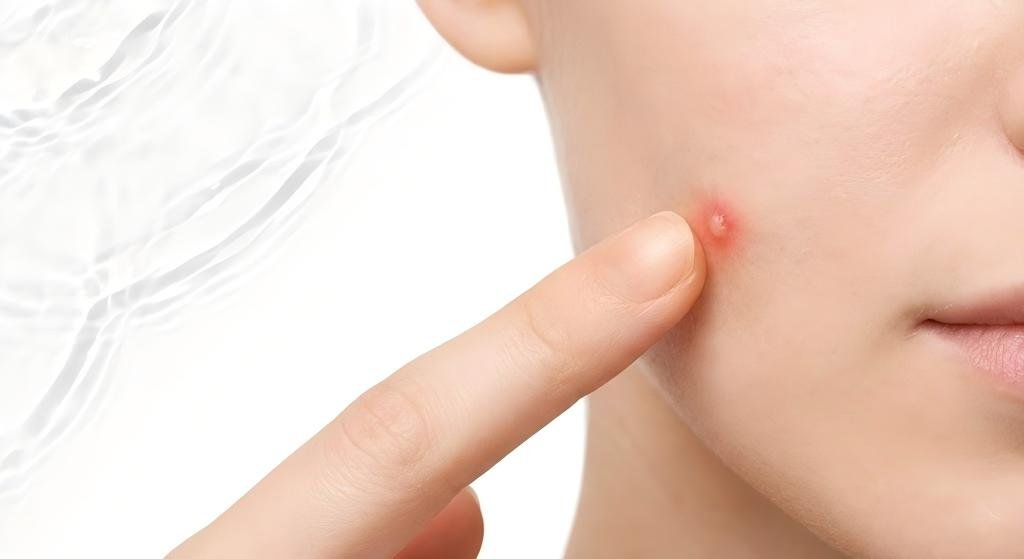
It often starts unconsciously. You are watching TV, reading an email, or staring into the bathroom mirror. Your hand drifts to your face, your fingertips scanning the landscape of your skin like a radar seeking a target. They find an irregularity—a bump, a crust, a clogged pore. Suddenly, a neurological loop engages. The urge to smooth out the irregularity becomes overwhelming, leading to squeezing, scratching, and ultimately, tissue damage. Minutes later, the ‘trance’ breaks, leaving you with a bleeding wound, immediate regret, and a vow to never do it again. This behavior, known clinically as Excoriation Disorder (or Dermatillomania), is a Body-Focused Repetitive Behavior (BFRB). While often dismissed as a ‘bad habit,’ it is actually a complex neurological event driven by the brain’s reward system. In this behavioral science white paper, we will move beyond simplistic advice like ‘just stop touching your face.’ Instead, we will explore a tangible engineering solution: Stimulus Control. We will analyze how using an Auslka hydrocolloid patch as a physical barrier for acne interrupts the neural feedback loop, effectively ‘short-circuiting’ the urge to pick before damage occurs.
- The Neuroscience of the Pick: Why Willpower Fails

To effectively stop picking pimples, we must first understand why the brain demands it. The cycle follows a classic Operant Conditioning model:
a.The Cue (The Tactile Scan)
Unlike other compulsions, skin picking is primarily tactile, not visual. The fingertips are densely packed with mechanoreceptors (Merkel cells). When they encounter an elevation (a pimple) or a rough texture (a scab) on the otherwise smooth skin, it registers as a ‘foreign object’ or ‘imperfection’ that violates the brain’s desire for symmetry and smoothness.
b.The Routine (The Pick)
The act of grooming or removing the imperfection is an evolutionary instinct gone wrong. The Basal Ganglia—the part of the brain responsible for motor habits—takes over, bypassing the Prefrontal Cortex (logic and decision making). This is why you often pick without consciously deciding to do so; it is an automatic motor reflex.
- The Reward (Dopamine Release)
Crucially, the moment of ‘popping’ or removing the crust releases a micro-dose of Dopamine—the brain’s neurotransmitter for relief and satisfaction. This creates a powerful reinforcement loop. Your brain learns: ‘Stress/Boredom -> Pick -> Relief.’ This is why subconscious skin picking is so difficult to break; your own biochemistry is fighting against you.
- Engineering Stimulus Control: The Auslka Barrier Method
In behavioral psychology, ‘Stimulus Control’ involves altering the physical environment to change behavior. The Auslka Hydrocolloid Patch is the ultimate tool for this, serving as an acne shield.
Tactile Dissonance (The Circuit Breaker)
When you apply a patch over a pimple, you fundamentally alter the sensory input:
- The Scan: Your finger glides over the face, seeking the familiar rough texture of a scab or bump.
- The Dissonance: Instead of a trigger, the finger encounters smooth, cool, matte plastic (Polyurethane).
- The Interruption: The ‘Imperfection Signal’ is never sent to the Basal Ganglia. The urge to pick is short-circuited because the tactile cue is missing.
This provides immediate skin picking disorder help not by forcing you to resist the urge, but by removing the urge entirely.
- The Pathology of “Acne Excoriée”: Why Scabs are Triggers
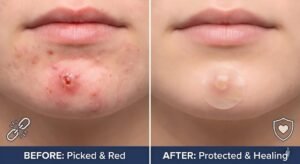
Ideally, we patch a pimple before picking. But realistically, many users turn to patches *after* the damage is done to aid in healing popped pimple trauma. Understanding wound healing is critical here.
The Vicious Cycle of Scabbing
A popped pimple is an open wound. The body’s natural Hemostatic response is to form a fibrin clot (a scab). Scabs are dry, itchy, contracting, and rough. To a picker, a scab is a ‘Texture Trigger’ even more powerful than the original pimple. Picking the scab re-opens the wound, resetting the healing clock and deepening the tissue damage.
The Hydrocolloid Solution
Auslka patches maintain a ‘Moist Wound Environment.’ This prevents the fibrin clot from drying out into a hard scab. Instead, the wound undergoes ‘Autolytic Debridement,’ where enzymes liquefy damaged tissue under the patch. Result: No hard scab forms. No texture trigger exists. The cycle of re-picking is physically impossible.
- Scar Prevention: Mitigating Permanent Damage
The long-term consequence of Dermatillomania is scarring. Using a patch is the most effective way to prevent acne scars, specifically addressing two types:
- Atrophic Scars (Icepick/Boxcar): These are caused by the loss of collagen during the inflammatory phase. By preventing the ‘re-opening’ of the wound via repetitive picking, hydrocolloid encourages rapid epithelialization, allowing collagen to regenerate evenly rather than forming a pit.
- Post-Inflammatory Hyperpigmentation (PIH): These dark spots are caused by melanin overproduction triggered by trauma and UV light. The Auslka patch acts as a UV shield and prevents the mechanical trauma that stimulates melanocytes.
- The 28-Day Habit Rehab Protocol
Breaking a BFRB takes approximately 28 days of consistent interruption. Here is the Auslka protocol:
- Week 1 (The Blockade): Apply patches to EVERY bump, real or imagined. Wear them 24/7. Your goal is to have zero direct skin contact. If you scan, you feel plastic.
- Week 2 (Night Defense): Focus on overnight acne protection. Many people pick subconsciously in their sleep. The patch acts as a guard dog.
- Week 3 (Trigger Identification): Start tracking *when* you want to pick (Stress? Boredom?). Use the patch application as a ‘Mindfulness Pause.’
- Week 4 (Healing): By now, old wounds should be healed without scabs. The tactile landscape of your face is smoother, reducing the urge to scan.
- Comparative Analysis: Patch vs. Willpower
| Parameter | Willpower Alone | Auslka Barrier Method |
| Success Rate | Low (<5% long term) | High (Physical intervention) |
| Sensory Input | Texture exposed (Trigger Active) | Texture smoothed (Trigger Removed) |
| Wound Environment | Exposed to bacteria/air | Sterile/Moist/Occluded |
| Healing Speed | Slow (Interrupted by picking) | Fast (Uninterrupted) |
- Clinical FAQ: Managing the Habit
Q1: I have severe Dermatillomania. Is this a cure?
A: While hydrocolloid patches are not a psychiatric cure for the underlying anxiety, they are a critical dermatillomania tips tool for ‘Harm Reduction.’ They minimize the physical damage, prevent infection, and buy you time to seek professional therapy.
Q2: Can I wear makeup over the patch?
A: Yes. Auslka patches feature a matte, light-diffusing finish. Applying concealer over the patch is infinitely safer than applying makeup directly into an open, picked wound, which can cause granulomas.
Q3: What if I already picked and it’s bleeding?
A: Don’t panic. Clean the area gently with saline. Pat dry. Apply the patch. It may turn white with blood/exudate very quickly. Change it after 4-6 hours. This prevents scab formation and speeds up closure.
Q4: Do you have patches for large picking zones?
A: Yes. Picking often happens in zones (e.g., entire cheek). Our XL Patches are designed to cover an entire ‘picking field,’ protecting multiple lesions simultaneously.
Final Thoughts
Stopping skin picking is not about having ‘better self-control’; it is about having better tools. By utilizing the Auslka Hydrocolloid Patch as a psychological and physical shield, you remove the sensory trigger that drives the dopamine loop. You are not just healing a pimple; you are rewiring your brain. Break the cycle today with our Acne Shield Collection.