

Chemical Warfare vs. Physical Engineering

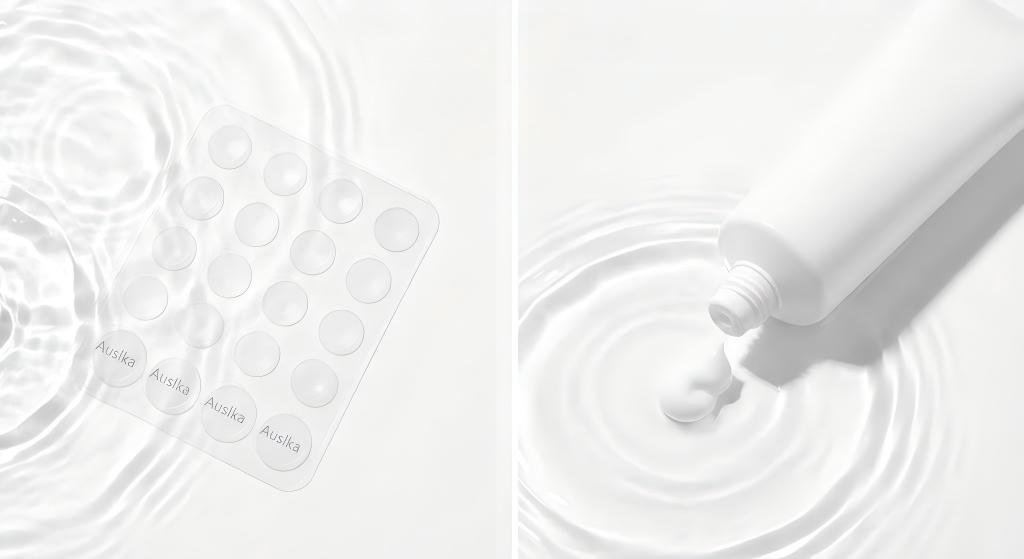
Pimple Patches vs Creams: Which Acne Treatment Works Faster?
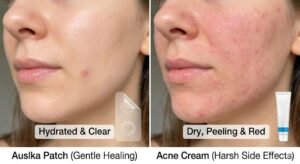
For decades, the dermatological standard for treating acute acne lesions was ‘Chemical Warfare.’ Patients were instructed to apply potent oxidizing agents like Benzoyl Peroxide (BPO) or keratolytic agents like Salicylic Acid directly to the skin. While effective at bactericidal reduction, these agents often lack precision, causing collateral damage to the healthy skin barrier. In recent years, a paradigm shift has occurred: the move from chemical bombardment to ‘Physical Engineering.’ The Hydrocolloid Patch represents this shift. In this comparative white paper, we will conduct a rigorous spot treatment comparison between traditional topical creams and modern hydrocolloid arrays. We will analyze the pharmacokinetics of pimple patches vs creams, focusing on Transepidermal Water Loss (TEWL), exudate management, and the physics of volume reduction.
a.The Old Guard: Why Chemicals Often Fail the “Speed Test”
To understand why patches are gaining market dominance, we must first analyze the limitations of the incumbents: Benzoyl Peroxide and Salicylic Acid.
b.Benzoyl Peroxide (The Oxidizer)
BPO functions by releasing free oxygen radicals into the pore, killing anaerobic C. acnes bacteria. However, oxidation is a destructive process. BPO strips the stratum corneum of Vitamin E and essential lipids, leading to a spike in TEWL. This results in the classic benzoyl peroxide drying effect: red, flaky, irritated skin that takes longer to heal cosmetically than the pimple itself. Furthermore, BPO is a potent bleaching agent, responsible for the consumer pain point of bleaching pillowcases and towels.
- Salicylic Acid (The Exfoliator)

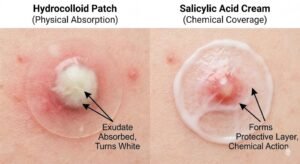
Salicylic Acid (BHA) works by dissolving the desmosomes (glue) holding dead cells together. While excellent for preventing blackheads (preventative), it is slow as a spot treatment. Why? Because it cannot physically remove the fluid volume from an inflamed pustule. It can only wait for the body to reabsorb it.
- The New Guard: Hydrocolloid Physics
Auslka patches operate on a completely different principle: Osmotic Pressure and Vertical Wicking.
Mechanism: Volume Reduction
Unlike creams which sit on the surface, a hydrocolloid patch creates a moisture gradient. It physically pulls the exudate (pus/oil) out of the pore and traps it in the polymer matrix. This immediate removal of fluid volume reduces pressure on the nerve endings (pain relief) and flattens the lesion instantly. This is why patches are clinically considered the superior fast acting acne treatment for whiteheads.
Mechanism: Occlusion & Barrier Repair
By sealing the wound, the patch maintains a moist environment. This prevents the formation of a hard scab, allowing epithelial cells to migrate faster to close the wound. While BPO destroys the barrier, hydrocolloid mimics it.
- The “Pink Lotion” Phenomenon: A Crusty Trap
Many users rely on bi-phase drying lotions (Alcohol + Calamine/Sulfur). These products work by rapidly dehydrating the skin surface. While they dry the pimple, they form a hard crust. This crust often traps bacteria and exudate *underneath*, potentially forcing the infection deeper. An Auslka patch is effectively a modern, safer mario badescu drying lotion dupe that works without the crust. Instead of drying the infection *in*, it draws the infection *out*.
- Comparative Analysis: The Showdown
Which modality wins? In the hydrocolloid vs salicylic acid debate, the answer depends on the lesion type.
| Metric | Topical Creams (BPO/SA) | Auslka Hydrocolloid Patch |
| Mechanism | Chemical Kill / Exfoliation | Physical Extraction / Protection |
| Side Effects | Erythema, Peeling, Burning | None (Hypoallergenic) |
| Barrier Impact | Destructive (High TEWL) | Reparative (Maintains Moisture) |
| Textiles | Bleaches fabrics permanently | Safe for all linens |
| Makeup Compatibility | Cannot apply over crusty cream | Can apply makeup over patch |
| Touching Protection | Zero (Pimple exposed) | 100% (Pimple shielded) |
Conclusion: acne cream side effects often outweigh the benefits for single spots, whereas patches offer a zero-side-effect solution.
- Scenario Protocol: When to Use What
Scenario A: The ‘Ripe’ Whitehead. Verdict: Patch. There is fluid to extract. A cream cannot remove volume; a patch can. It is the ultimate overnight zit zapper.
Scenario B: The Field of Blackheads. Verdict: Cream (BHA). Hydrocolloid cannot extract dried, oxidized sebum (blackheads) efficiently. Use a Salicylic Acid toner for these areas.
Scenario C: The Blind Cyst. Verdict: Hybrid. A standard patch won’t extract fluid, but an Auslka Microneedle or Tea Tree Patch is superior to cream because occlusion drives the active ingredients deeper than a topical application can reach.
- Clinical FAQ & Usage Guide
Q1: Can I put cream *under* the patch?
A: Generally, no. Creams (especially those with moisturizing bases) create a slippery lipid film that prevents the hydrocolloid from adhering to the skin. Furthermore, trapping strong actives like Retinol or high-% Benzoyl Peroxide under an occlusive patch can cause chemical burns.
Q2: Which treatment works faster?
A: For flattening a raised, fluid-filled bump, the patch is faster (6-8 hours). For drying up a weeping sore, the patch is faster. For unclogging a non-inflamed blackhead, Salicylic Acid is faster.
Q3: Do patches prevent scars better than creams?
A: Yes. Creams do not stop you from picking or scratching. Patches provide a physical barrier that prevents mechanical trauma, which is the #1 cause of atrophic scarring and hyperpigmentation.
Q4: Is it safe for pregnancy?
A: Plain hydrocolloid patches are drug-free and 100% safe for pregnancy. Benzoyl Peroxide and Salicylic Acid (in high doses) often carry warnings or require doctor consultation during pregnancy.
Q5: Will patches cause ‘Purging’ like Retinoids?
A: No. Purging occurs when cell turnover is accelerated, bringing micro-comedones to the surface all at once. Hydrocolloid is passive; it only treats the specific spot it covers. It does not alter your skin’s lifecycle.
Q6: Can I use both in the same routine?
A: Yes, but spatially separated. Apply Salicylic Acid to your T-Zone for blackhead prevention, let it dry, and then apply Auslka patches to any active whiteheads on your cheeks or chin.
Final Thoughts
The era of burning your face to cure acne is over. While topical creams still have a place in preventative maintenance (field therapy), the Auslka Hydrocolloid Patch offers a targeted, physical solution that works with your body’s healing mechanism rather than against it. Don’t dry it out—draw it out. Upgrade your toolkit with the Auslka Acne Care Collection.