

From Concept to Shelf: The Complete Private Label Cosmetics Manufacturing Process

Introduction


Navigating the global beauty supply chain is frequently a devastating endeavor for independent brand founders. The industry is saturated with agonizing operational pain points: missed launch deadlines, catastrophically non-compliant formulas failing customs inspections, and profound factory miscommunications that result in thousands of unsellable units. It is entirely understandable why founders experience immense anxiety during the scaling phase. However, to mathematically eradicate these systemic vulnerabilities, partnering directly with a technologically advanced private label cosmetics manufacturer is the absolute operational mandate for guaranteeing commercial survival and sustained profitability.
Many emerging beauty entrepreneurs mistakenly assume that outsourcing production merely involves selecting a formula from a catalog and applying a logo. In reality, scaling a cosmetic product from a 50-milliliter laboratory beaker to a 5,000-liter industrial homogenization vat introduces severe thermodynamic and rheological challenges. A minor miscalculation in shear rate or cooling velocity can irreversibly shatter an emulsion, entirely destroying a massive bulk batch of product. Bypassing these catastrophic failures requires profound integration with a facility operating under strict Good Manufacturing Practice for Cosmetics (GMPC) frameworks.
This comprehensive B2B technical guide will aggressively deconstruct the end-to-end Cosmetics OEM process. We will systematically dissect the industrial engineering behind high-shear homogenization, detail the strict microbiological quarantine protocols required for global compliance, and provide the objective workflow architecture necessary to transform a raw chemical concept into a flawless, retail-ready cosmetic line.
Core Infrastructure & GMPC Automation Advantages

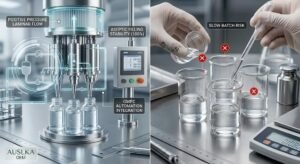
To objectively comprehend the manufacturing superiority of an elite OEM, industrial engineers must first deeply analyze the thermodynamics of bulk cosmetic processing. A premium cosmetics factory operates fundamentally differently than an artisan laboratory. The core of the facility revolves around massive, multi-ton vacuum emulsifying homogenizers. When compounding a complex water-in-oil (W/O) emulsion, the introduction of atmospheric oxygen into the mixture during high-speed agitation creates severe oxidative stress and millions of microscopic air bubbles, compromising the specific gravity of the product.
To counteract this, an advanced GMP cosmetics factory mathematically seals the homogenization vessel and draws a massive vacuum. The internal rotor-stator homogenizer then spins at ultra-high velocities (frequently exceeding 3,000 RPM), violently shearing the lipid and aqueous phases into sub-micron droplets. Because this entire mechanical collision occurs in an oxygen-free vacuum, the resulting emulsion possesses flawless textural uniformity, superior rheological stability, and absolute resistance to premature oxidation.
Furthermore, ambient atmospheric contamination poses a lethal threat to cosmetic integrity. State-of-the-art facilities completely isolate their filling lines inside Class 100,000 (ISO 8) positive-pressure cleanrooms. These hyper-controlled architectural spaces utilize massive HVAC arrays to force incoming air through industrial High-Efficiency Particulate Air (HEPA) filters. By maintaining a higher atmospheric pressure inside the cleanroom than in the surrounding hallways, the facility mathematically prevents the ingress of airborne pathogens, dust, and yeast spores. Automated aseptic filling machines then extrude the bulk liquid directly into primary packaging without a single instance of human contact, permanently neutralizing the threat of microbial contamination before the product is even sealed.
Critical Workflow & Real-World Launch Cases
The physical deployment of a new cosmetic SKU requires absolute adherence to a linear, rigorously documented engineering pipeline. The workflow initiates with the Product Development Brief. During this phase, brand founders communicate their precise organoleptic requirements (texture, scent, absorption rate) and active ingredient targets to the OEM’s analytical chemists. Consequently, the laboratory team engineers a preliminary 50-milliliter prototype. Furthermore, if the brand requests specific regional botanicals—such as high-purity, subcritical fluid-extracted Centella Asiatica sourced directly from Guizhou, China—the chemists must mathematically balance these complex polyphenols against the base preservative system. Therefore, the formulation undergoes multiple iterative adjustments until absolute chemical equilibrium is achieved.
Once the client signs off on the final prototype, the formula mathematically enters the mandatory stability testing phase. Consequently, the sample is subjected to violent thermal cycling within specialized environmental chambers, fluctuating between -20°C and 45°C over a highly compressed 90-day period. Furthermore, the formulation undergoes severe centrifuge testing to simulate years of gravitational pull, ensuring the emulsion does not structurally separate. Therefore, the OEM facility mathematically guarantees the product will survive international shipping logistics and maintain a pristine 36-month shelf life. This rigorous protocol is unconditionally required whether the product is a complex Anti-Acne Series or a standard hydrating lotion.
Finally, the transition from lab-scale to bulk manufacturing is initiated. Consequently, the chemical engineers must calculate the precise scale-up thermodynamics. A formula that cools perfectly in a 50ml beaker will retain massive internal heat when compounded in a 2,000-liter vat. Therefore, the facility utilizes specialized jacketed cooling tanks to precisely regulate the thermal drop of the bulk liquid, preventing the rapid crystallization of fatty acids that would otherwise ruin the texture. Furthermore, by orchestrating this exact industrial pipeline, a premium beauty brand supply chain completely shields the founder from catastrophic batch failures, ensuring the final retail product is an exact molecular clone of the approved laboratory sample.
Comparison Table: Supply Chain Architectures
To objectively evaluate the structural and financial viability of varying cosmetic supply chains, procurement engineers must critically analyze the deployment data. The following 4-column table mathematically contrasts Professional GMPC Factories against highly flawed, legacy industry alternatives across critical performance metrics.
| Manufacturing Model | Quality Control & Regulatory Safety | Lead Time Predictability | Unit Cost Economics |
| Professional GMPC OEM Factory | Supreme. ISO 22716 certified, rigorous microbial and heavy metal testing. | Highly Predictable. Automated lines guarantee strict delivery schedules. | Excellent. Massive economies of scale drastically lower the cost per unit. |
| Trading Companies (Middlemen) | Variable. You have zero direct visibility into the actual production facility. | Poor. Prone to severe communication delays and unverified excuses. | High. The middleman inherently injects a massive markup on the factory price. |
| Small Batch Hand-Pouring (DIY) | Terrible. Extreme risk of cross-contamination and inaccurate preservative dosing. | Unscalable. Physically impossible to fulfill a massive viral sales spike. | Astronomical. Purchasing raw chemicals in micro-quantities destroys margins. |
| Overseas Dropshippers (No MOQ) | Catastrophic. Zero compliance with FDA/MoCRA or EU regulations. Illegal to scale. | Volatile. Shipping individual units globally causes massive customer service failures. | Deceptive. Cheap upfront, but shipping costs and high refund rates ruin profitability. |
Supply Chain Best Practices & QC Specs
Executing a flawless commercial launch requires absolute, uncompromising adherence to strict supply chain quarantine protocols. The moment raw chemical materials arrive at a premium OEM facility, they are immediately placed into physical quarantine. The internal analytical chemistry laboratory must intercept these materials and utilize High-Performance Liquid Chromatography (HPLC) to mathematically verify the purity of the compounds. If a batch of active botanicals deviates from the established baseline, the entire drum is instantly rejected and returned to the supplier. This prevents contaminated or diluted raw materials from ever entering the custom skincare production cycle.
Furthermore, the microbiological safety of the final bulk product must be unequivocally proven before it is dispensed into primary packaging. The facility executes rigorous Preservative Efficacy Testing (PET), intentionally inoculating the bulk formula with massive colonies of virulent pathogens (such as E. coli and Staphylococcus aureus) to mathematically guarantee the internal preservative system rapidly destroys the biological threat. Concurrently, the bulk undergoes strict Inductively Coupled Plasma Mass Spectrometry (ICP-MS) analysis to certify that all heavy metal concentrations (lead, arsenic, mercury) are strictly below the draconian thresholds mandated by international regulatory bodies.
Finally, the secondary packaging assembly is subjected to strict mechanical tolerances. As the primary containers (bottles, jars, compacts) exit the aseptic filling line, they are subjected to automated torque-testing to ensure closures are mathematically tightened to prevent transit leakage. The units are then precision-fed into automated cartoning machines, where lot numbers and exact expiration dates are laser-etched directly onto both the primary vessel and the secondary paper box, ensuring absolute traceability in the event of a global recall. For highly complex structural packaging, such as air-cushion compacts, refer to our specialized Makeup Series assembly protocols.
Frequently Asked Questions (FAQ)
- How many lab sample revisions am I permitted during the R&D phase?
Standard OEM contracts typically include 2 to 3 complimentary revision rounds for custom formulations (ODM). If you require further adjustments to the texture, scent profile, or active ingredient concentration after the 3rd round, the laboratory will usually charge an additional, nominal R&D fee to cover the ongoing chemical compounding and testing costs.
- Will the factory provide the COA and MSDS required for importing my cosmetics?
Absolutely. A compliant GMPC factory automatically generates a Certificate of Analysis (COA) for every single production batch, proving microbiological and chemical compliance. They also provide the Material Safety Data Sheet (MSDS), which is legally required by international freight forwarders and customs officials to clear your products at the port of entry.
- Can the OEM handle international export logistics and freight forwarding?
Yes. Premium manufacturers operate comprehensive export departments. They hold the necessary global export licenses and have deep logistical partnerships with major maritime and air freight carriers. They will calculate the optimal palletization architecture, secure the required shipping containers, and manage the complex customs declarations required for DDP (Delivered Duty Paid) or FOB (Free On Board) shipping terms.
- What happens if I want to switch my packaging design after the formula is approved?
If the new packaging utilizes a different extrusion mechanism (e.g., switching from a standard pump to a fine-mist sprayer or an airless pump), the OEM laboratory must pause production and re-execute a rigorous packaging compatibility test. This ensures the fluid dynamics of the formulation will physically pass through the new nozzle without clogging or reacting negatively with the new plastic resin.
- How long does the bulk manufacturing and filling process take?
Once the final formulation is approved, the packaging is physically received at the facility, and the mandatory 12-week stability testing is complete, the actual bulk compounding, aseptic filling, and secondary packaging assembly typically requires exactly 30 to 45 days, depending strictly on the mechanical complexity of the selected primary packaging.
- Do I legally own the exact formulation if I use a private label OEM service?
If you utilize a ‘Private Label’ model—where you select an existing, pre-stabilized factory formula from their catalog—the OEM retains the intellectual property (IP) of that base chemical structure. However, if you execute a true ‘Custom Formulation’ (ODM) and pay the upfront R&D engineering fees for the chemists to invent a unique formula exclusively for your brand, you typically retain total legal ownership of that IP.
Conclusion
The engineering reality within the global beauty market is irrefutable: attempting to navigate the volatile landscape of cosmetic production without the massive technological infrastructure of a professional manufacturing partner guarantees catastrophic financial loss and brand destruction. By migrating your brand’s supply chain directly to a precision-engineered private label cosmetics manufacturer, you permanently mathematicalize your product’s safety, stability, and global market readiness. You guarantee absolute compliance with international GMPC standards, eradicate the threat of batch inconsistency, and unlock the flawless scalability required to dominate your sector.
Do not compromise your brand’s operational survival with archaic middlemen or substandard DIY facilities. Whether you are engineering a complex, active-heavy skincare line or require a high-throughput manufacturing partner to execute a massive global rollout, explore the immense capabilities of our advanced ISO-certified infrastructure. To understand our stringent quality control frameworks, visit About Us. Secure your commercial dominance by upgrading your supply chain today. Contact the industrial engineering specialists at Auslka to receive a customized thermodynamic production audit, and fundamentally revolutionize your beauty brand’s trajectory.