

Private Label Skincare Series: The Ultimate OEM Manufacturing Guide

Introduction

The contemporary global beauty market is characterized by relentless volatility and aggressive competition. For independent beauty founders, dermatology clinics, and emerging aesthetic brands, navigating the initial launch phase is fraught with severe operational and financial pain points. The dual threats of formulation instability and crippling Research and Development (R&D) overhead routinely paralyze new ventures before they even reach the market. Moreover, devastating supply chain delays can completely derail a carefully orchestrated product launch. To mathematically eradicate these mechanical and financial vulnerabilities, partnering with an elite Original Equipment Manufacturer (OEM) to deploy a premium private label skincare series is no longer a luxury; it is a strict business mandate.
By bypassing the agonizing trial-and-error of independent compounding, visionary brand owners can immediately access a vault of pre-stabilized, clinically validated formulations. This strategic outsourcing completely neutralizes the immense capital expenditure traditionally required to build Good Manufacturing Practice (GMP) compliant cleanrooms and hire dedicated cosmetic chemists. Instead, capital can be efficiently redirected toward aggressive brand acquisition and marketing.
Developing a custom cosmetics formulation through a specialized cosmetics ODM or OEM allows founders to leverage massive economies of scale from day one. In this comprehensive B2B technical guide, we will aggressively deconstruct the biochemical thermodynamics of advanced emulsion systems, detail the critical regulatory compliance required for global distribution, and explain exactly why partnering with a premier beauty brand manufacturing facility is the ultimate catalyst for explosive commercial scaling.
Core Biochemical & Formulation Advantages

To objectively evaluate the necessity of advanced cosmetic manufacturing, brand founders must first deeply analyze the severe chemical complexities inherent in topical formulations. Creating a biologically active Skincare Series is a rigorous exercise in biochemical thermodynamics and molecular stabilization. Modern consumers aggressively demand potent active ingredients—such as L-Ascorbic Acid (Vitamin C), encapsulated Retinol, Niacinamide, and multi-molecular weight Hyaluronic Acid. However, these specific active compounds are notoriously volatile and highly reactive.
For example, unencapsulated Vitamin C rapidly oxidizes when exposed to ambient light, thermal stress, or atmospheric oxygen. This degradation not only renders the serum biologically useless but also alters its aesthetic profile, turning the formulation a highly unappealing brown. To prevent this chemical collapse, a premier Skincare OEM manufacturer utilizes advanced micro-encapsulation technology. This sophisticated process wraps the volatile active ingredient in a microscopic, biocompatible lipid sphere, completely shielding it from environmental and chemical stressors until it makes direct contact with the human epidermis. This guarantees absolute chemical stability on the retail shelf and maximum bioavailability upon dermal application.
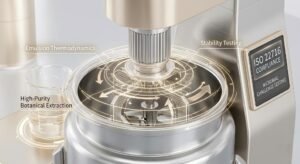
Furthermore, constructing a cohesive line requires absolute mastery over emulsion thermodynamics. A standard moisturizing cream is fundamentally an emulsion of water and lipid phases—two substances that naturally repel each other. Cosmetic chemists must utilize precise mathematical ratios of complex emulsifiers, rheology modifiers, and broad-spectrum preservatives to ensure the product does not undergo phase separation or cultivate dangerous bacterial growth over its designated 36-month shelf life. By leveraging the immense R&D infrastructure of a professional OEM facility located in a dominant hub like skincare manufacturing China, brand founders instantly access thousands of pre-stabilized base formulas. These sophisticated bases can be rapidly customized with ultra-pure botanical extracts. Notably, advanced extraction facilities in regions like Guizhou, China, provide some of the world’s most potent, organically cultivated botanical derivatives, utilizing subcritical fluid extraction to guarantee zero thermal degradation of the fragile molecular compounds.
Critical Market Applications & Real-World Use Cases
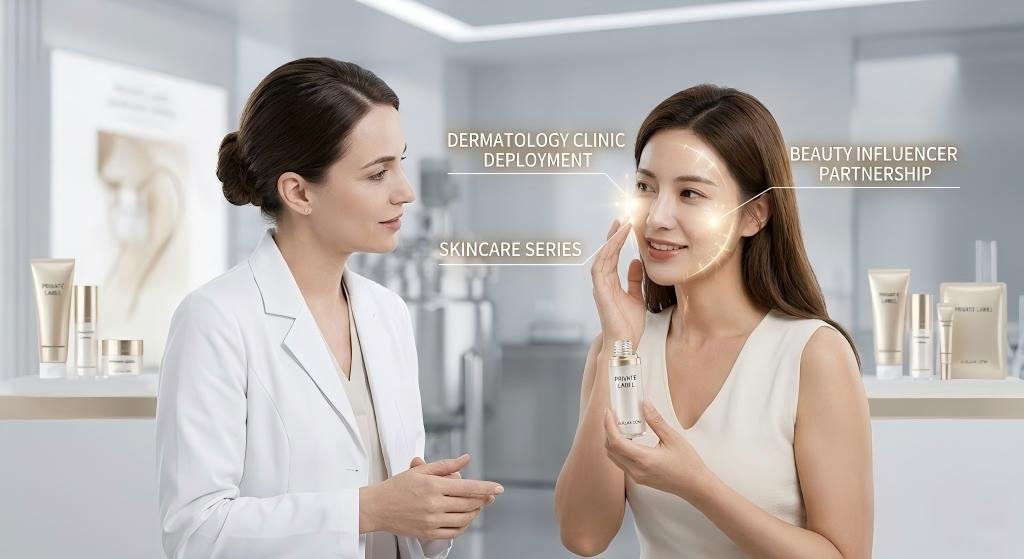
The strategic deployment of a private label skincare series is heavily dictated by the specific clinical or aesthetic demands of the target consumer base. In the highly specialized sector of professional dermatology clinics and medical spas, practitioners require post-procedure formulations that strictly aid in epidermal barrier repair without inducing localized erythema or contact dermatitis.
Therefore, these medical professionals actively procure customized, sterile OEM formulations packed with bio-identical ceramides and soothing peptides. Consequently, when a patient undergoes an aggressive chemical peel or laser resurfacing, the clinic can immediately prescribe their proprietary branded recovery cream. Furthermore, this internal product distribution strategy significantly elevates the perceived authority of the clinic while simultaneously creating a highly lucrative, recurring revenue stream that is entirely independent of the practitioner’s billable hours. Therefore, the OEM model perfectly serves the financial and clinical objectives of the medical aesthetic sector, particularly when deploying an Anti-Acne Series for sensitive demographics.
Furthermore, in the hyper-accelerated realm of social media commerce, beauty influencers and digital-first brands utilize these manufacturing partnerships to aggressively monetize their massive audience reach. Consequently, when a specific skincare trend—such as skin-cycling or barrier-repair slugging—goes viral on platforms like TikTok or Instagram, an influencer cannot afford to wait 18 months to formulate a product from scratch. Therefore, they leverage the agile infrastructure of a specialized cosmetics ODM.
By selecting a highly stable, pre-tested OEM base and modifying it with a signature scent or a trending botanical extract, the influencer can execute a rapid product launch in less than 60 days. Consequently, this unparalleled speed-to-market allows them to capture peak consumer demand before the algorithmic trend inevitably dissipates. Furthermore, because the OEM factory handles the complexities of bulk manufacturing, aseptic filling, and primary packaging assembly, the digital brand owner can remain hyper-focused on content creation and customer acquisition. Therefore, the strategic application of OEM manufacturing completely democratizes the beauty industry, allowing lean, agile brands to aggressively capture market share from lumbering legacy corporations.
Comparison Table: Skincare Manufacturing Models
To objectively evaluate the logistical and financial viability of cosmetic production, brand founders must critically analyze the different manufacturing architectures. The following 4-column table mathematically contrasts Top-Tier OEM Skincare Manufacturing against alternative models across critical business metrics.
| Manufacturing Model | R&D Cost & Formulation Ownership | Speed to Market (Lead Time) | Scalability & Quality Control |
| Top-Tier OEM (Private Label) | Zero R&D costs. Brand leverages pre-tested, highly stable factory base formulas. | Extremely Fast (Typically 30 to 60 days). Immediate deployment. | Infinite scalability. Factory assumes all GMP and ISO compliance risks. |
| White-Labeling (Off-the-Shelf) | Zero customization. Brand simply slaps a logo on a generic factory product. | Instant (Immediately available for shipping). | High scalability, but zero product differentiation or market uniqueness. |
| In-House Formulating | Astronomical. Brand pays for internal chemists, lab equipment, and testing. | Very Slow (12 to 24 months). Requires extensive microbial testing. | Poor. Highly vulnerable to supply chain disruptions and cleanroom failures. |
| Traditional ODM (Custom Form) | High R&D fees. Factory invents a completely unique formula specifically for the brand. | Slow (6 to 12 months). Requires brand-new stability and challenge testing. | High scalability, but requires massive Minimum Order Quantities (MOQs). |
Manufacturing Best Practices & Quality Specs
Executing a flawless global product launch requires absolute adherence to strict international dermatological regulations and uncompromising quality control protocols. A premium skincare or Makeup Series line must be manufactured in a facility that strictly complies with ISO 22716 and GMPC (Good Manufacturing Practice for Cosmetics) standards. These rigid, internationally recognized frameworks mathematically dictate every facet of the production environment. This includes the implementation of multi-stage reverse osmosis (RO) microbiological filtration for the primary water supply, and the mandate for positive-pressure, HEPA-filtered ventilation systems that physically prevent airborne particulates and biological contaminants from entering the high-shear mixing vats.
Furthermore, before any custom cosmetics formulation is approved for mass commercial production, it must survive a brutal gauntlet of physical and microbiological stress tests inside the OEM facility’s internal quality control (QC) laboratory. The most critical evaluation is the Preservative Efficacy Testing (PET), commonly known as Challenge Testing. This rigorous process involves intentionally inoculating the cosmetic sample with massive colonies of virulent bacteria, yeast, and mold (such as Escherichia coli, Pseudomonas aeruginosa, and Staphylococcus aureus). The laboratory technicians then mathematically track the logarithmic reduction of these pathogens to definitively prove that the product’s preservative system can rapidly and completely neutralize biological threats.
Additionally, the product must undergo extreme thermodynamic stability testing. The formulation is placed in specialized environmental chambers that violently cycle the ambient temperature between deep freezing (-20°C) and extreme heat (45°C) over an accelerated 90-day period. If the emulsion separates, experiences a drastic shift in pH, or drops in viscosity, the formula is immediately rejected and sent back to the chemical engineers for recalibration. By partnering with an OEM that enforces these draconian QC protocols, brand owners guarantee that their products will remain perfectly stable, safe, and highly effective under any global shipping condition.
Frequently Asked Questions (FAQ)
- What is the standard Minimum Order Quantity (MOQ) for a high-end private label skincare series?
MOQs are heavily dictated by primary packaging constraints rather than the bulk liquid itself. For standard OEM formulations utilizing factory-owned, in-stock packaging (like standard acrylic jars or glass droppers), MOQs can frequently start as low as 1,000 to 3,000 units. However, custom-molded glass or specialized airless pumps typically push the MOQ to 10,000 units.
- Can I engage in ‘toll manufacturing’ where I supply my own proprietary botanical extracts?
Yes, advanced OEM facilities frequently offer toll manufacturing. You can supply a patented active ingredient, and the factory’s chemical engineers will mathematically incorporate it into an existing stable base emulsion. However, mandatory compatibility testing must first be executed to ensure your raw ingredient does not neutralize the base’s preservative system or break the emulsion.
- How does the factory guarantee compliance with international cosmetic regulations?
A premier manufacturer maintains a dedicated regulatory affairs department. They strictly adhere to the EU Cosmetics Regulation (EC) No 1223/2009 and the FDA’s MoCRA guidelines. They will automatically generate the required Material Safety Data Sheets (MSDS), Certificates of Analysis (COA), and assist with the compilation of the Product Information File (PIF) for seamless global export.
- What is the difference between an OEM and an ODM in the cosmetics industry?
OEM (Original Equipment Manufacturer) typically refers to ‘private label,’ where you select a pre-developed, fully tested factory formula and customize the branding and packaging. ODM (Original Design Manufacturer) involves paying the factory’s R&D lab to engineer a completely unique, proprietary chemical formula from scratch exclusively for your brand’s use.
- How do I ensure my custom formulation remains cruelty-free and vegan?
You must strictly mandate these requirements during the initial contracting phase. The OEM facility will meticulously audit their supply chain to source raw materials (like squalane or glycerin) strictly from plant-derived origins rather than animal byproducts. Furthermore, they will provide documentation proving that neither the raw ingredients nor the finished formulas have been subjected to animal testing.
- Does the OEM factory assist with the graphic design of primary and secondary packaging?
Yes, comprehensive OEM partners operate as fully integrated turnkey solutions. Their in-house design teams will assist you in mapping vector graphics onto the primary containers (via silkscreen printing or hot stamping) and provide precise die-cut templates for your secondary paper boxes, ensuring the final retail presentation perfectly matches your brand’s architectural aesthetic.
Conclusion
The engineering reality within the global beauty market is irrefutable: attempting to scale a cosmetics brand without the massive technological infrastructure of a professional manufacturing partner is a severe operational liability. By migrating your brand’s production to a precision-engineered private label skincare series developed by an elite OEM facility, you permanently mathematicalize your product’s safety, stability, and market readiness. You guarantee absolute compliance with global GMPC standards, eradicate the threat of chemical instability, and unlock rapid speed-to-market for your entire product catalog.
Do not compromise your brand’s reputation with substandard formulations. Whether you are seeking to launch an advanced anti-aging line or require a high-throughput Brand OEM/ODM manufacturing partner for an expansive cosmetic empire, explore the immense capabilities of advanced infrastructure. To understand our 30-year legacy of formulation excellence, visit About Us. Secure your operational dominance by upgrading your supply chain today. Contact the cosmetic engineering specialists at Auslka to receive a customized formulation audit, and fundamentally revolutionize your beauty brand’s trajectory.